Wednesday, April 12, 2017

A Ming-Inspired Cabinet (91)

Today’s work began with some simple hole drilling in ½" square aluminum bar stock:


The bottle contains not water, but denatured alcohol, which I use as a cutting fluid. It prevents the gummy aluminum from welding itself onto the end of the drill bit, as it is prone to doing. I picked up the tip to use denatured alcohol from a Youtube video by a machinist in Germany, and it works really well.

The holes are offset an exact amount from one another:


I mentioned in the last post the use of collets, and for those readers who might be curious, here are a couple of the 444E collets, one ½" and one ¼", and collet nut:


The aluminum bar was then chopped off on the sliding table saw, and bolted up to one of the vise jaws with some ¼"-20 pan head screws:


The little Wiha ratchet you see above is part of a set I recently received for my birthday. After the Japanese ceiling project around New Years’, I realized a need for a tiny ratchet which fitted ¼" hex shank bits instead of the regular type of ¼" drive ratchet plus socket, which prove to be too large in confined spaces. the Wiha was my choice, and my wife came through with this little metal case of goodies:


It comprises more than 60 pieces, and utilizes a ¼" hex drive adapter to run tiny 4mm shank bits. But of course one can snap any old ¼’ shank bit into the tool no problem. There is an extension as well as an anti-static diver for use with electronics. It should prove handy from time to time.

The case is made of some nice thick metal too:


The set up complete, onto the woodwork we go. Up today are the hammerhead draw bars which joint the cabinet case to the support stand. The blanks were first prepared by the usual jointing planing resawing and super surfacing, followed by some work on the sliding tablesaw to cut to length and then kerf the pieces crosswise. At the end I had a pile of 9 pieces:


Only 8 pieces are required, however at last, with such small bits of wood, I could afford a spare piece. Such luxury!

The aluminum piece I had made earlier and attached to the vise jaw serves as a stop to register the piece in the vise:


After cutting both sides with a test pass, measuring the result and then adjusting the mill’s z-travel accordingly, I milled the pieces. The resulting neck dimension was right on target:


A while later, all 9 pieces were done without mishap:


Next step was to chamfer the perimeter of the hammer heads:


Then I used the sliding table saw with the blade canted over at 22.5˚ to chamfer the small ends of the draw bars:


It’s funny when you take the step of planning in an extra stick and nothing goes awry. But, 8 were all that were needs so one went in the trash.

Half of the draw bars were then fitted to the sill crosspiece of one of the stands:


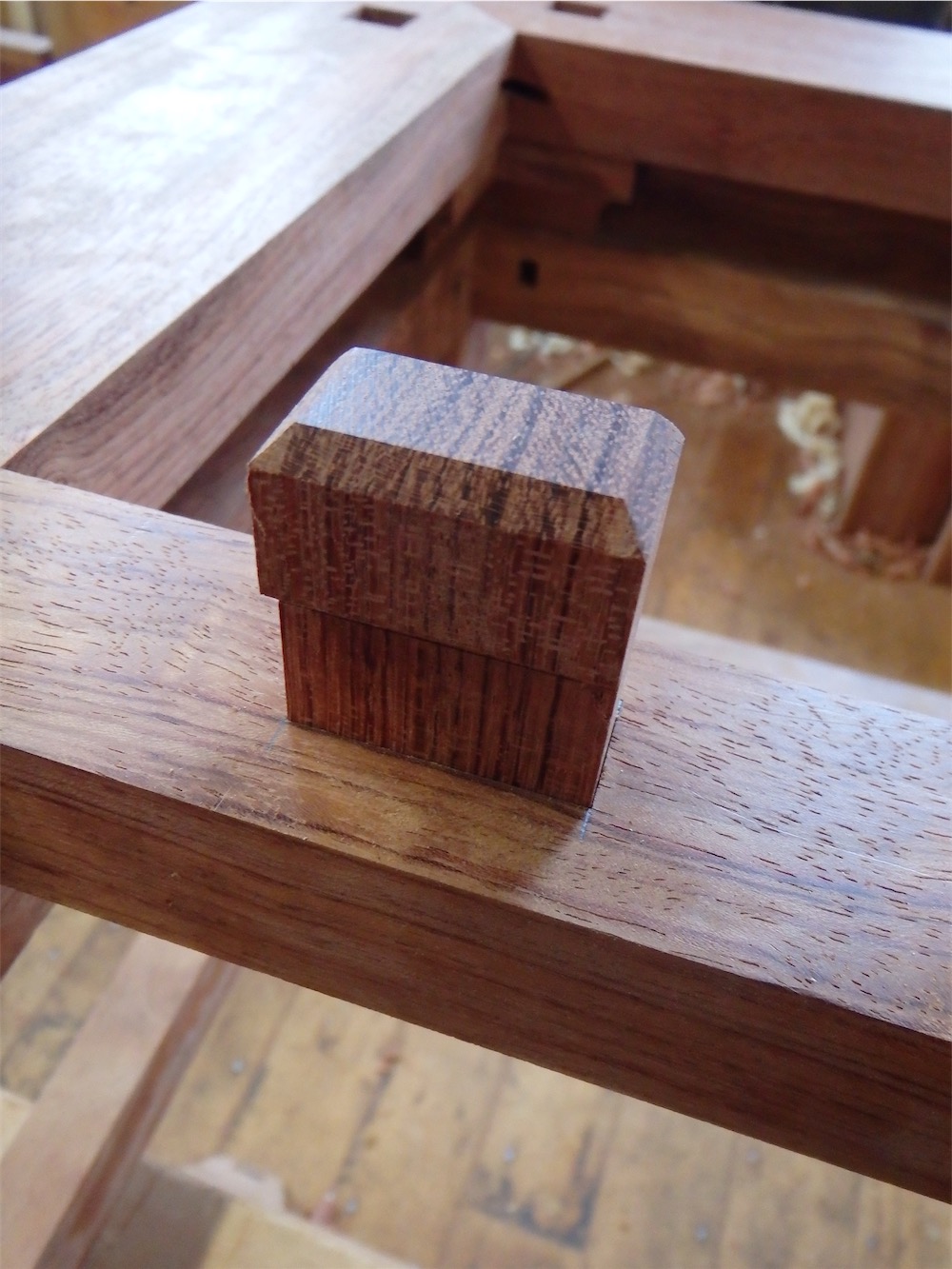
A closer look at a couple of them:


Next step was to fit the same 4 draw bars to the bottom board of the carcase:


When installed, the hammer heads sit in a 3/8" deep recess, leaving a total of ¼" of the pin protruding:


Next was a step I’ve been awaiting for quite some time, namely placing the cabinet box upon the stand:


Similar to how I marked out the door hinge centers on the bonnet cornice piece previously, I employed a custom-machined brass transfer pin in place of the pivot pin at the bottom of the stile:


The door is positioned at the correct offsets and alignments, in preparation for marking the hinge center:


The draw bars were all driven down and into position and the location of the carcase relative to the sill was carefully measured to confirm it was where it should. Only minor tweaking was required, which was a good sign.

If you poke your head down below and look up, you can see where the hammerhead bars emerge:


These will be fitted with crosswise wedging pins very soon. I’m thinking I’ll use Gabon ebony for those wedges, if I have any kicking around.

Anyhow, the perfect world of the drawing for this cabinet had the hinge centers falling exactly upon the sill miter lines. I was curious to see how close i got to those lines after all the fabrication, of the sills themselves, the carcase, the hinge stiles on the doors, and the hinge pin centers on the door stiles.

The left side miter line first:
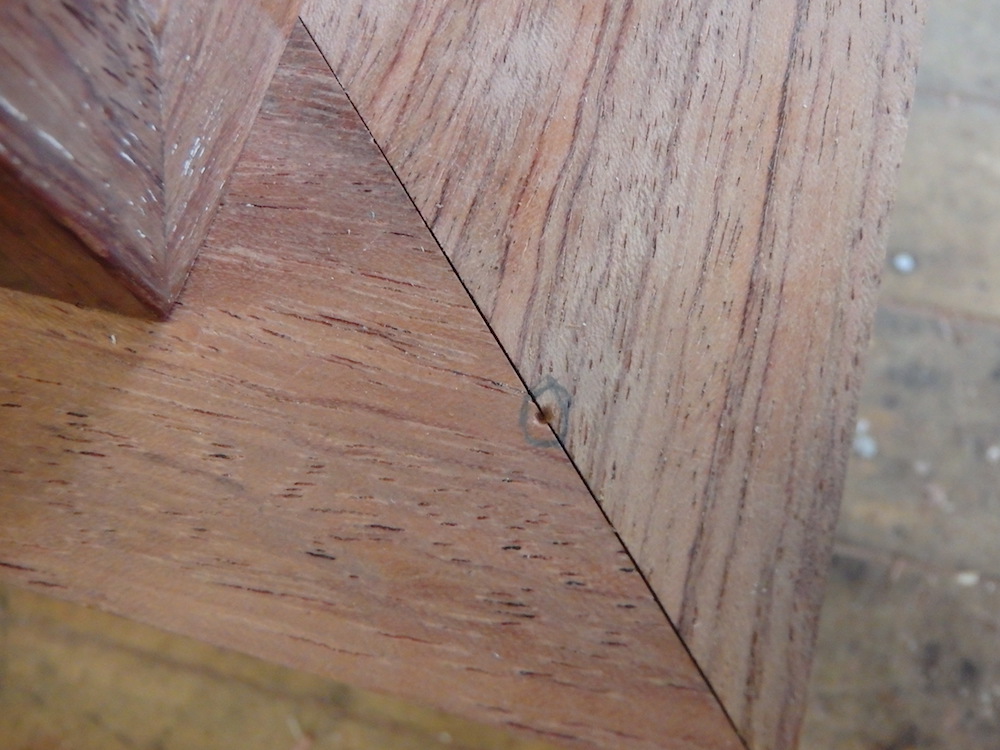

Don’t worry about the miter being slightly open, as the locking pin, or shachi sen, has yet to be driven into that joint. They will close up nice and tight soon enough.

The right side miter line was just missed by a hair with the center point:


Overall, I was very pleased with the way things turned out today:


While I was working on the above, interspersed were rounds of finishing work on the bonnet cornice assemblies which I had started last time (not illustrated). At this juncture, they have 3 coats of finish. I plan to put 5 coats on the very front edges of those assemblies, so these should be done in another day.

Tomorrow I’ll repeat the same process of assembling carcase to stand and marking out the door centers on the stand’s sill miters. Once that’s done I can proceed to drill out those places for the bronze bushing which will be fitted. I can also complete assembly of the sills themselves and get them into finish.

Thanks for visiting the Carpentry Way.

via Tumblr https://davidpires578.tumblr.com/post/159512126629

Tuesday, April 11, 2017

A Ming-Inspired Cabinet (90)

In the past couple of days I picked up a 5/8" (15.875mm) brad point drill, made by Fisch, and a 7/8" (22.22mm) Forstner bit out of Famag’s ‘Bormax’ line. These were the tools needed to complete the upper hinge receivers in the cabinet’s upper sill/cornice pieces.

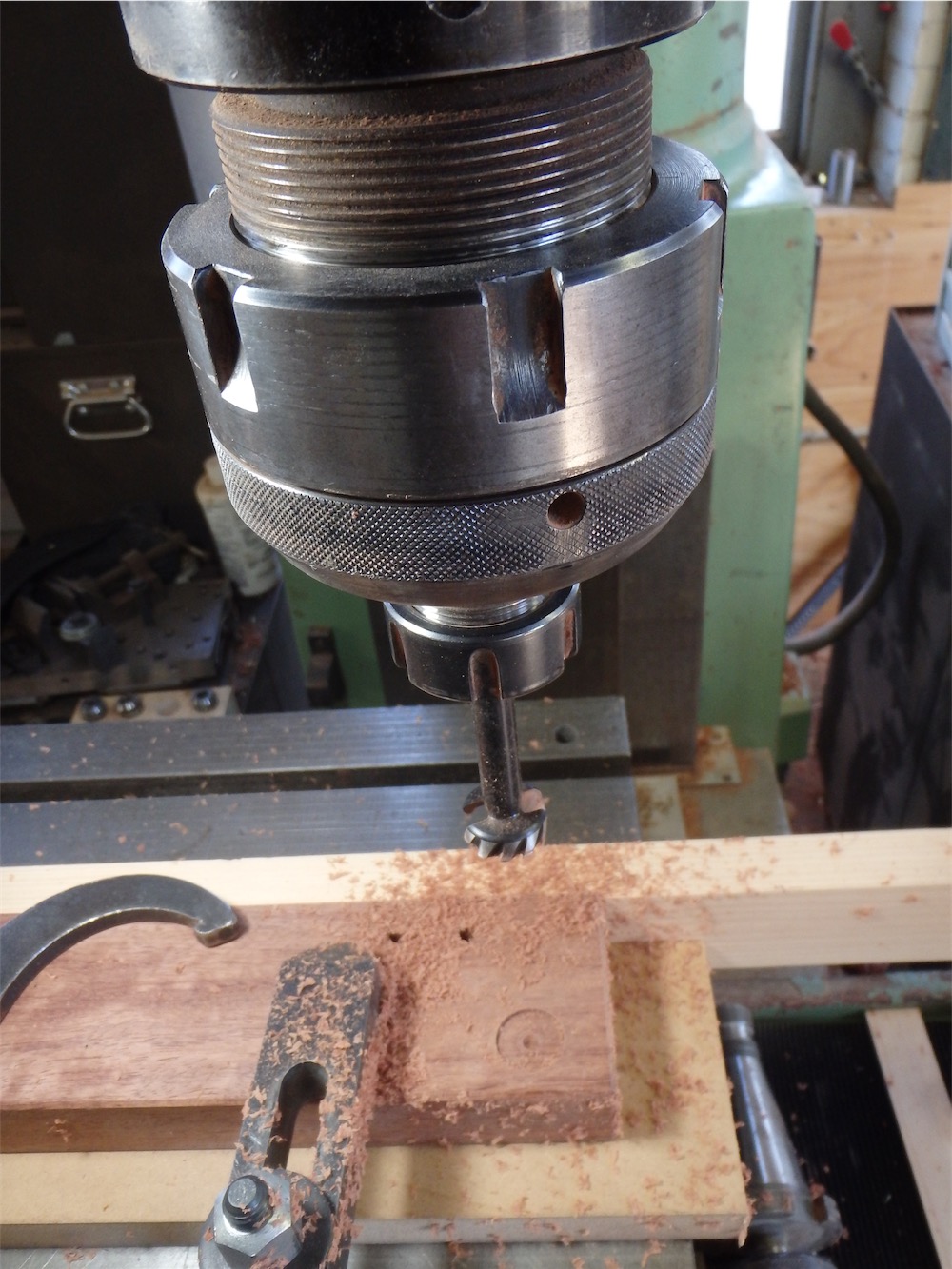
The Bormax, designed for hardwood, was just the ticket of cutting the counterbore for the flange on the bronze plain bearing. Of course, the natural tool for (quasi-) precision drilling was the Zimmermann mill, once again:


Target depth for the counterbore is 0.0625":


I like the Bormax bit as it cut cleanly and without burning- I think I’ll spring for a boxed set of this at some point later on.

One significant advantage to using a mill rather than a drill press, besides the obvious greater rigidity and accuracy is the tool holding. This might not be obvious to folks unfamiliar with milling machines, so I thought it worth a mention.

In a regular drill press the Forstner would have been held in a 3-jaw drill chuck. This is generally adequate to be sure, especially with higher quality chucks, but I have found that, especially with larger Forstners, the torque load while cutting can overwhelm the chuck holding capacity and this leads to the shank of the bit spinning slightly in the jaws of the chuck, marring the surface of the shank. This in turn can lead to the shank becoming sufficiently damaged that it no longer allows for concentric spinning of the bit. One solution to this is to have a bit with a hex shank, however this is not available, it seems, for every type of large bit.

In the mill, while I could use a chuck, it is generally preferable to use a collet holder. In the case of the Bormax bit, the shank is 10mm, and I happen to have a ER27 collet in that size. With a collet, which is normally encountered in woodworking only in a router, the shank of the bit is gripped much more completely on its surface, instead of only at 3 points, and thus there is far less chance of shank slippage. Total indicated bit runout (TIR) is also significantly less with a collet as compared to a chuck.

In truth, if you want a truly accurate hole, besides dispensing with the 3-jaw chuck and moving to collets, one would also not use a drill of any kind to make the final hole. Rather, one would drill and undersize hole and then use a boring bar to clean the hole to the required size. In this case, going to that extent is unnecessary as the interface between the bushing and the wood is simply a decent slip fit, and I can get there with the drills I have on hand.

One disadvantage to collets is that the gripping range of an individual collet is limited, and thus to cover a wide range of shank sizes you need many collets. So, in my case, I have but a modest collection of collets at this point - and two different collet chucks with different collet standards (ER27 and 444E) so in cases where I do not have the right size collet for a drill, I need to use the 3-jaw chuck. I would prefer the collet though, and am gradually acquiring a full range of sizes. The chuck I have goes to 5/8" shank size maximum, while I have collets in the 444E type which go up to 25mm in diameter.

One final note is that collets are a wear item, and have only a finite lifespan as an accurate tool holder. I haven’t run into that limit yet, probably because I am not doing work at an accuracy level where collet wear becomes apparent.

Next, I’m checking that the counterbore is a good fit for the flange of the bushing:


The flanged bushings themselves are extremely accurately made, pretty much bang on dimension down to a thousandth of an inch (about 0.025mm), so the above was really just a check of the result from the drilling with that Bormax.

Onto the through hole with the 5/8" brad point:


While the hole was bored cleanly enough, though not without some complaint from the bit, the hole itself proved to be a hair too small for the bushing. What the…?

I checked the drill with a caliper:


5/8" is 0.6250".

So, a brand new brad point from Fisch was about 0.005" undersize. Fail. Won’t be buying any more from that company, and will return the bit to the Woodcraft store. Once bitten, twice shy. Fisch’s quality control seems to be lacking to say the least - I guess I thought that an Austrian company might have better products than that.  Mind you, I don’t know for a fact that the bit is in fact made in Austria - it might come out of China.

I wonder who does make a decent, accurately-dimensioned, large brad point through? I’m guessing there will be something in Germany that would fit the bill - any readers who know a good brand to recommend for future reference?

Anyway, I happened to have a decent 5/8" Forstner kicking about, and by running this through the bore hole I managed to enlarge the hole to the required size:


As it turned out, drilling with the 5/8" Forstner alone on subsequent holes made for a bit too much work for the bit in such a hard wood as bubinga - it tended to burn in the cut - so I ended up using the undersize brad point followed by the Forstner for all the holes. A bit of added faffing about, but the results were what counted in the end.

All the way down into the counterbore and things shaped up as I hoped they might:


On the upper face the bushing came nearly to the surface, as desired:


With both mounting holes for the plain bearings completed on one frame, I proceeded to final assembly. I planed up some ¼" (6.35mm) pegs, tapered and chamfered their ends, and then placed them in preparation to be driven:


Once the pegs were down, and trimmed off both sides, using a crosscut saw followed by a small router, a first coat of finish could be applied:


By the end of the afternoon I had the frame for the second cabinet through to the same stage. Time now to tackle the hinge mounting holes on the lower sills. I’ll save that for the next post in this series.

I hope you enjoyed your visit to the Carpentry Way.

via Tumblr https://davidpires578.tumblr.com/post/159444916209

Monday, April 10, 2017

My Journey As A Creative Designer - Woodworking and Beyond #1830: Brushing up on Organization

Those of you who know me realize that I am an ‘Organizational Junkie’.  


Yes – I am actually very proud of that fact. I grew up with very limited means and I was taught to respect and take care of the things we have. Throwing them here and there only causes them to get lost or damaged. Besides – how can we be efficient if we have to stop and look for stuff while we are in the midst of creating? Maybe others can work that way, but I sure can’t. 


Last year when we moved into our new place here, I was fortunate enough to gain a real studio in which to do my work. It is located in a corner room and has windows on two walls, making it bright and cheerful. In addition to all the natural light, I decided to add a white rug and all white furniture as a base for it. This way I have a 'blank canvas’ with which to decorate and it lends to the openness and cheerfulness of the room. 


My artist friends thought I was CRAZY! (So did many of my other friends) But I have had white rugs and light furniture before in my past lives and never had a problem keeping them clean. It only takes a certain amount of care and upkeep to keep it looking nice. 


Now we are about nine months later, and I am proud to say that everything looks as nice as it did when it was brand new. Perhaps even better as I add some things to the room here and there. I have a wonderful workplace that is clean, neat, functional and inviting in which I spend my days. I am really happy. 


One of the keys to keeping it nice is to keep up with the organization aspect of the room. I still have a little 'fine tuning’ to do as far as my needlework and embroidery supplies go, but for the most part, I keep things in order. This doesn’t happen automatically, though. It takes a couple of minutes after each session to put things back where they belong so that the next time I need them, I am able to find them quickly and not interrupt my workflow. It is a basic behavior that I am happy to say is a 'habit’ with me and it makes my life much easier and more productive as well. When people ask how I accomplish so much in a day, I know that this is a large part of the reason. A little time spent each day to take care of our very beautiful and expensive supplies really pays off in the end. I can’t have it under way. 


So recently, I have been searching for some new sources of brushes to recommend to my customers and readers. I used to use the Lowe-Cornell 7000 series of brushes, which was a higher end of brush from them. But in recent years, the company has changed hands numerous times and they have not only become more expensive, but harder for me to get, too. My favorite was a 20/0 liner that I have had for over 10 years and still use. It seems that they just don’t make them the same anymore. 


I also had a stash of 'teaching brushes’ that I would bring when I taught. Since that hasn’t been for a while, I felt it was time to sort through the piles of brushes I have and put the ones that I use most for my own painting. Last night I posted pictures of my progress and I had a lot of interest from my painting groups and some of my other followers as well. I thought that putting everything into one comprehensive post would be a nice idea for those who want to reference it. So here it is. :) 


I use the upper part of my large cabinet to store my brushes, current paint project supplies, and several types of my colored pencils. I had my cabinets custom made so they are very deep since I had the room.


The trick is not to put stuff in front that blocks the stuff behind it if you can help it. The area in front is kind of a 'temporary holding area’ where I can quickly tuck my paint and current project away when I am done for the evening. You will see that in later photos. 


I began by laying most of my 'current brushes’ over the middle of the floor:


This was the only way that I could actually sort them into groups. I grouped them (for the most part) by brand and type. I then decided which ones I really use all the time and which I do not and only use for teaching or backups. Once that part was done, I was well on my way to getting things in a good place. The rest was easy. 


I began by using two of my decorative boxes for storing the brushes that I don’t use frequently. 


The box on the left holds my large Home Decor Brushes. Most are Americana Decor from DecoArt. I LOVE them. I was given some Blue Ice to try and I haven’t done that yet. I heard good about them and they seem nice, so I will let you know. 


The box on the right holds my 'extras’ that I used for teaching or had from way back when. Many are Loew-Cornell, which I LOVED. But the company has changed hands many times and I don’t know if they will have a good future. Others are several brands that I tried and didn’t make the cut for one reason or another. Some lost their shape. Others fell apart, others just performed poorly. I am a very light painter and take good care of my brushes. There is no reason that they shouldn’t hold up well. I hate to even give many of these away because they are … well … CRAP


I then filled a brush holder with many of my most commonly used brushes. These are mostly filled with my old Lowe-Cornell favorites and the many beautiful DecoArt Traditions brushes that I use. If you want a good brush, you can get the DA Traditions through Art Apprentice Online  http://store.artapprenticeonline.com/all-brushes/.  They occasionally do put them on sale for 30% off and I buy them then. I do like them a lot. They are excellent quality.


The left side of my cabinet is filled with my different types of pastel pencils, Derwent pencils of various types, and watercolor paints. On top of that, I keep my wet palettes and water basin. In front are 'treats’ that I send out with my orders and right now there is a wood order there, too. Everything is easy to get to. 


On the middle and right side, there are my two drawers for storing my brushes (they were pulled out in the first picture) and on top of it is a box that will hold my 'current project paints, pattern and surfaces’ if they fit. That way I can tuck them away quickly.  On the far right in back are the two boxes and the brush holder that I showed you all, which stack up neatly and are easily accessible, as you see. In front of it is a brush bucket to hold the larger brushes that I don’t want to squish in the drawers. You will see them in a minute. 


Now we will show all the drawers. We will start at the bottom and work our way up. I put the lesser used brushes in the bottom and the more frequently used ones in the top. That way if some small things are on the shelf, I don’t have to move them every time I go into the drawers. (By the way – the drawers are available from Mary Kingslan Gibilisco here: https://www.kingslan.com/proddetail.php?prod=brushboxbrushkit


I am numbering from the bottom up. Drawer #1 -


First – my favorite stencil brushes – Laurie Speltz makes the best (I think it is creativecoach.com) I love her stenciling brushes! 


Next – Styluses – (can we ever have too many??? ) I use mine for other things and sometimes bend them. 


Next – Heather Reddick sable brushes for her beautiful stroke work. There are some mini sable mops there, too. 


Finally – some palette knives, a small utility knife, and a drafting pencil.


Drawer #2

First compartment – EMPTY (Room for MORE! :D )

Second are some new Royal ZEN brushes. They are really reasonable and so far I like them. Mary Kingslan Gibilisco sells them and you can get them around Charlotte Fletcher – you may like these. I do because they are similar to the Lowe-Cornell 7000 series anglers in feel. If they last – GREAT!

<div>Next – My Kolinsky Sable brushes. Mostly from Yarka. High quality and a bit costly. The darker one is from the DA Traditions line sold by Art Apprentice Online. </div>
<div></div>
<div>Finally – Royal Sabletek from Mary Kingslan Gibilisco. These are really nice (the ones I tried) but I still need to try more of them. You can see they aren’t used yet. They feel like really nice quality.


<div>Drawer #3 </div>
<div></div>
<div>Mary Kingslan Gibilisco mops. High quality and they don’t shed. </div>
<div></div>
<div>Then the DecoArt Traditions Flats. BEAUTIFUL brushes. </div>
<div></div>
<div>Next the DecoArt Traditions rakes and domes. These are I think my favorite domes ever. Very nice for dry brushing. They are firm but have a beautifully soft and rounded head. Not as stiff as the LC deerfoot brushes. I love them! </div>
<div></div>
<div>Finally – the DecoArt Traditions Angular Shaders. These are nice, but they are a bit “fuller” than I like for my smaller stuff. I like using the chisel edge of the angular shader for lining and fur and stuff like that. These are a little full for that. But for bigger stuff, they are nice and they do hold their shape well. I use mine a lot.


Drawer #4 – This drawer is all Mary Kingslan Gibilisco’s
<div></div>
<div>First the flats. They are beautiful and have a somewhat shorter bristle. This is because she works a lot with the Genesis paint which is much thicker than the DA Americana Acrylic. They work really well with the thicker paint and have beautiful control. </div>
<div></div>
<div>Next are the angular brushes and more, smaller flats. Same here. </div>
<div></div>
<div>Then the filberts. Really nice quality handles and they keep their shape well. </div>
<div></div>
<div>Finally, the liners and spotters. Again – all beautiful brushes. I really like this line and use it often.


<div>Drawer #5 – This is my 'workhorse’ drawer. I actually got most of these brushes really CHEAP from Ebay. I haven’t tried many of them yet, but I did for the painting I did last week and they did an amazing job for the price. </div>
<div></div>
<div>The first section is the liners. I think they cost about $6 for ALL of them!  </div>
<div></div>
<div>The second section is the flats. I like that they have longer bristles so you can load it up fuller for basing without getting the paint int the ferrule. I will have to see if they hold their shape well. </div>
<div></div>
<div>The third is a set of angular brushes. These came long handled and I cut them down on my saw. I like shorter handles. They are a 'thin’ angular brush without lots of hairs, so working on the chisel edge is good with these. They were cheap, cheap, cheap though. I don’t know how they will hold up. </div>
<div></div>
<div>The last section is four of my Lowe-Cornell 20/0 liners. I love these for lettering and I am afraid they will go the way of the dinosaur with the company changing hands again. I had one of these for over 10 years! It was my favorite for teeny, tiny details. The other brush is a Royal Mini-Majestic Monogram brush. I like it, but I forgot where I got it. It is short though so it isn’t as good for lettering. I need one to hold more paint.


<div>Drawer #6 </div>
<div></div>
<div>First section – these are the brushes that Lynne Andrews uses. You can get them from her site at www.lynneandrews.com. I am painting her Ark series and wanted to actually follow her technique and directions. I will let you know on them. </div>
<div></div>
<div>The next three sections belong to Peggy Harris. I just got these brushes last week and I think they will be my NEW favorites. Peggy works with Silver brush directly and created some of these amazing brushes. The green handled ones are the Ruby series, which is stiffer so it doesn’t hold a lot of paint, but is great for precision work. They almost feel like fabric brushes. I absolutely fell in love with them. </div>
<div></div>
<div>The next section (white handles) are the Silver Ultra Minis. I used some of these for the fine details on a painting last week and LOVE them! They will probably replace my Lowe-Cornell 20/0 liner in the previous drawer because the liner holds a bit more paint and has a bit more control. I look forward to working more with these! </div>
<div></div>
<div>The last section are miscellaneous brushes from Peggy’s site (https://peggyharris.com/harris-brushes/)  With Peggy being a lifetime artist, she really knows her stuff and I trust her products. I am going to be looking into more brushes from Silver that she told me would be suitable for my preference for painting. I am excited because so far, these are really wonderful. It would be nice to be able to not have to keep hunting for my 'perfect’ line of brushes. In the long run, it will save me from buying every brush that I think with be “it”.


And finally – My brush bucket:


On the left pile, there are my larger Mary Kingslan Gibilisco brushes. Anglers and flats mostly. In the middle are some dynasty angles and domes. They are nice, but the anglers are thick for my every day painting. But they can be used for blending my colored pencil drawings with the odorless mineral spirits. 


On the right, the Dynasty Faux Squirrel brushes. These are nice and hold lots, so they will be good for my watercolors. These were my favorite of the Dynasty brushes. I had trouble with the Black/Gold that everyone raves about. I march to a different drummer, I suppose. 


Sitting on the top of the bucket is Peggy Harris’ beautiful Ultimate Varnish brush. I had to indulge in this brush! It is truly top of the line. Behind that are some large blenders from the Traditions line and some mops. 


As you see, everything fits nice and neat and is easily accessible:


I hope you liked this 'tour’ of my brushes. You can get Peggy Harris’ brushes on her website here: https://peggyharris.com/harris-brushes/


Mary Kingslan Gibilisco sells both brushes and the boxes here: https://www.kingslan.com/


And finally, the DecoArt Americana Traditions brushes are sold at Art Apprentice Online here:  http://store.artapprenticeonline.com/all-brushes/


Art Apprentice Online often puts them on sale for 30 percent off. :) 


In other news, we are updating the site today and sending out a newsletter. Keith has a new basket available (SLDK717) and we have some new sales.


I hope you stop by.  Look for your newsletter to arrive later on today. 


I hope you enjoyed seeing my brush organization. I think it is really helpful to keep things in order and I hope it gives you some ideas about some of the brushes you would like to try. 


Have a great Tuesday! :) 


</div>
</div>
</div>


via Tumblr https://davidpires578.tumblr.com/post/159415686014

Thursday, April 6, 2017

A Ming-Inspired Cabinet (89)

As one door closes, another opens, as they say:


After the battens are removed, the tenons can be kerfed for their wedges:


Result:


The teeth on that particular rip saw have virtually no set, and I find it tends to be difficult to keep sawing in a straight line, however the kerf is nice and slim.

Then the battens get a coat of wax, and later are to be rubbed with #0000 steel wool along with the panel. No point taking more pictures of door construction as that was covered in the preceding post.

Time ticked on, at a pace of completing roughly a door a day, and at last the 4 doors on the client’s cabinet were all together:


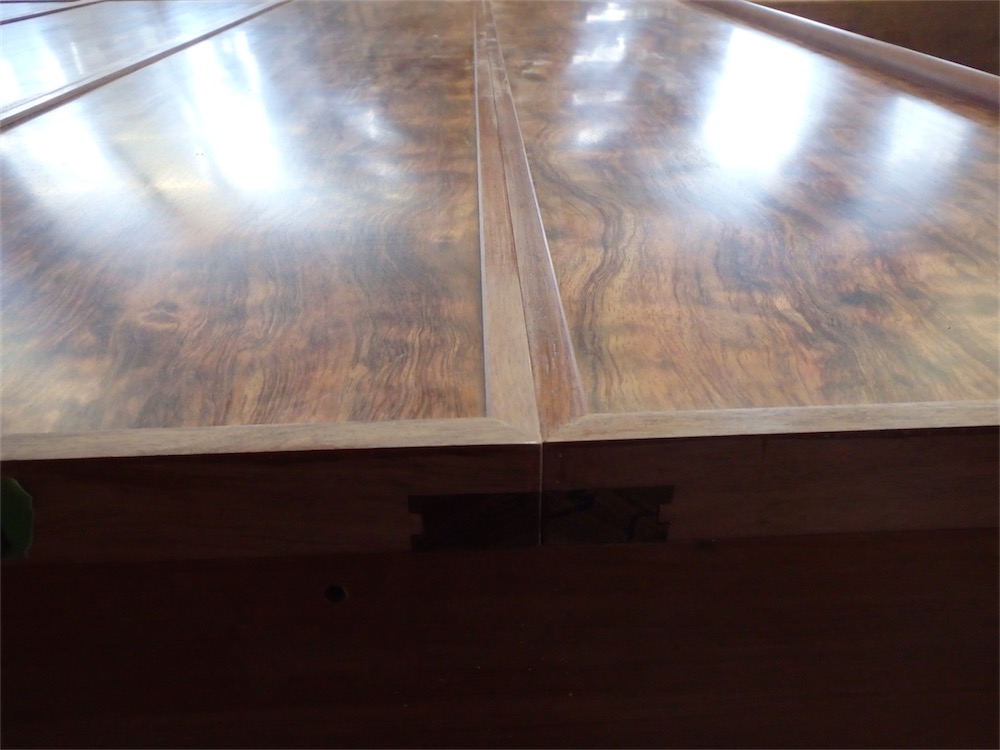
The ‘L’-shaped stiles show their purpose to good effect, I think, once the doors are next to one another, as it allows for a maximal view of the panels with the least interruption.

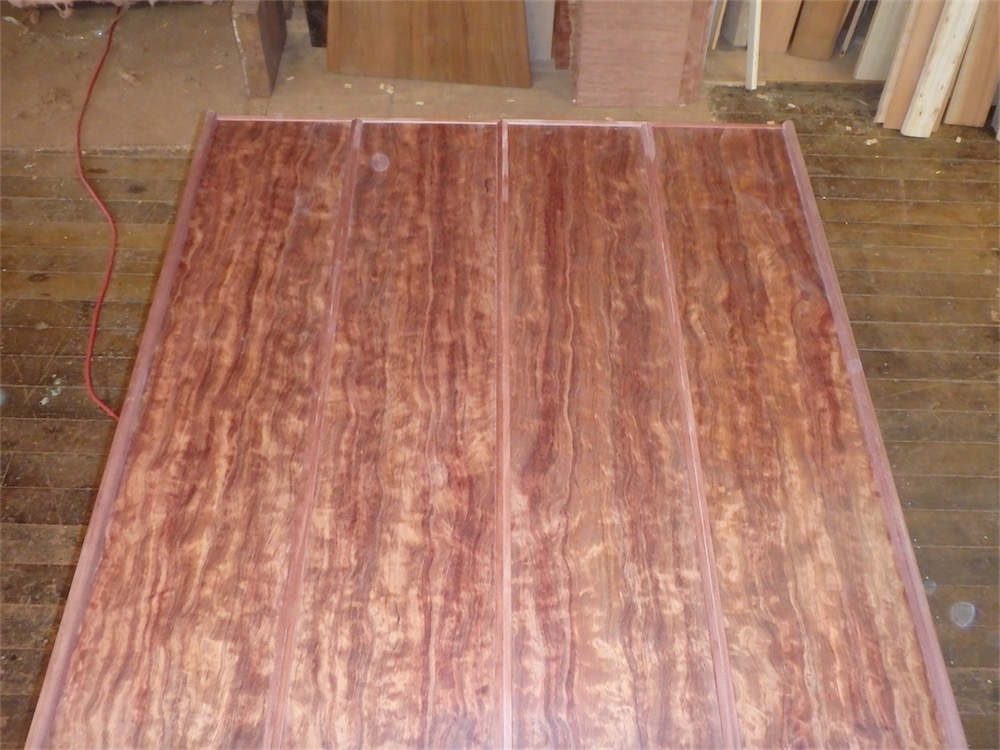
The panels and their frames came out straight and flat:


Another view:


I was a little nervous imagining worst case outcomes, but the panels fit to the carcase as they should, and there’s only a little work to do yet in regards to getting the spacing between panels just right.

Another view:


The doors were then completed and in place on the other cabinet:


The second from the left door was rotated upside down at the point I took the photo, and has since been flipped around. Looks a bit better that way!

The next step, before doing any further work to the door frames (they still need some finish applied), is to locate the hinge pin centers on the upper bonnet sill (or cornice) and then the same to the support stand sill. These two sills have to be dealt with one at a time for this step.

It was nice to fit the bonnet back on, after months of it sitting off the cabinet, and once it had dropped onto the dovetail keys and slid into position, I used a rubber mallet to bring it precisely into the correct offset from the front edge of the carcase:


With the offset as it should be, I fastened the securing bolts down:


I clamped some sticks to the side of the carcase to serve as guides to keep the edges of the doors in line with the outside walls of the cabinet:


Then the doors were placed on a couple of paper shims so as to create, for marking purposes, an expansion gap for the stile between the stile and the cabinet carcase:


To transfer centerline marks for the threaded inserts already fitted to the hinge stiles, I had a local machine shop turn a point on a 5/16" bolt a few week’s back, and this was then threaded into the insert:


Then it was simply a matter of sliding the door forward until the point left its mark on the underside of the sill:


Once both sets of outer doors had been marked to the upper cornice, before removing the upper sill assemblies I took a look at the task of drilling to those marks so as to fit the bronze bushings, however I then realized I lacked a 5/8" brad point bit. That’s something I’ll pick up tomorrow, along with a 7/8" Forstner as mine has been resharpened once or twice and is no longer dimensionally accurate.

It seems to me if the diameter of a Forstner is critical to the task at hand, then you can’t use a resharpened one. You have to use a new bit. They’re disposable tooling in that sense. The head of the Forstner is tapered so any machining done to refresh the cutting edge will move the edge down that taper and thus the diameter will decrease by a slight amount. Of course, for non-critical hole diameters, a resharpened Forstner is just fine, thank you very much. It’s the very same issue as with router bits.

All for this round. I’m glad to be largely done with the doors, as it was the last significant piece of construction on these cabinets.  Once I get the hinged stile doors fitted to the sills, I will make any required final adjustments to the frames of the middle panels and then can look at fitting the hinges between the panels so as to make them bifold doors. That will be happening in the near future.

Thanks for dropping by the Carpentry Way.

via Tumblr https://davidpires578.tumblr.com/post/159279473414